From Handwritten Fixture Card to Shared Calendar
Compare rugby fixture cards and shared calendars to see how each shapes a season’s record, preserves club memories, and handles changes without confusion.
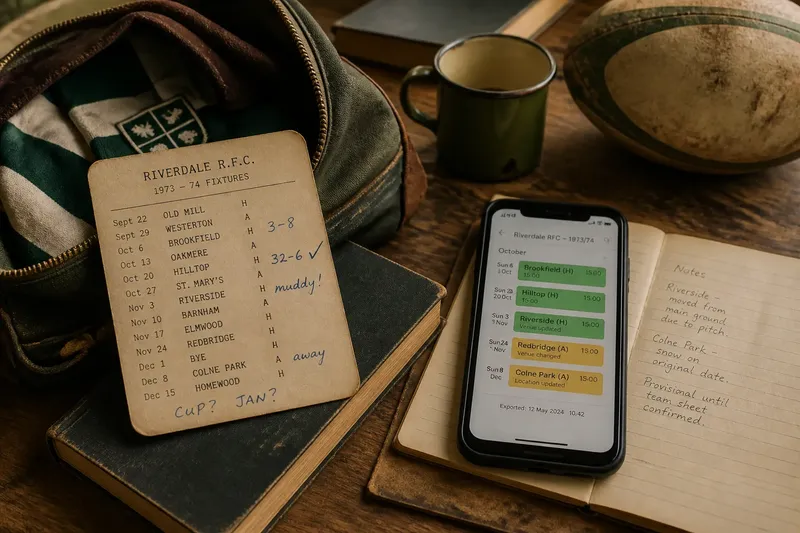
A fixture card folded into a kit bag can preserve a season’s shape long after the last whistle; a shared calendar can keep a changed venue attached to the date. The history of rugby fixture cards and shared calendars is not simply a switch from paper to screens. Each format leaves a different kind of record, and each asks members to remember the season in a different way.
For a club historian, the card may hold traces of how fixtures were presented at a particular moment. A calendar, by contrast, can show the schedule as it was revised. Comparing the two reveals not only how clubs shared dates, but what kinds of evidence survive when a season has passed.
Rugby fixture cards preserved a season in a fixed form
A printed sheet, a small card, or a handwritten list could give a player the whole run of fixtures in one view. A surviving copy may carry details that an abstract list does not: the club name as printed, the opponents selected for display, and perhaps a pencil mark beside a match that mattered to its owner.
Its fixed form is also a limit. A card records what was written or printed on it; it does not automatically preserve a later move of venue or kickoff. If someone corrected one copy by hand, another copy could retain the earlier information.
When looking at an old card, separate what it directly shows from what you infer. A handwritten score or annotation may be meaningful, but its author and timing may not be clear without other context.
Read the marks as evidence, not as a complete account of the season.
Shared calendars preserve revision as well as the fixture
A digital calendar can carry an event through changes to its date, location, or notes. Depending on the service and the way it is maintained, members may see the current entry while the calendar’s edit history or archived copies preserve earlier versions.
That record is different from a paper artifact. A calendar entry may include a ground address or a link, but it can be separated from the conversations and decisions that led to a change. A screenshot or exported file may show one state of the schedule without showing what came before or after.
For a historical record, keep context with the schedule where possible: the calendar name, the season, the date an export was made, and any notes explaining whether fixtures were confirmed or provisional. Do not assume that an entry visible today captures every earlier version.
Paper and digital records answer different historical questions
A card is useful for asking what a club chose to print or circulate. A calendar is useful for asking how a schedule was maintained and revised. Neither necessarily answers why a fixture changed, who made the decision, or which version members actually saw.
Say you are cataloging an invented, hypothetical club archive with a printed card that lists a match at the home ground and a later calendar export that lists a nearby field. First, record the card’s wording and any handwritten marks without treating them as verified updates. Next, note the export’s calendar name and capture date. Then compare the two and describe the venue difference as a documented discrepancy, not proof of when or why the move occurred.
That distinction keeps a small collection useful to future readers. Preserve the artifact itself, and label your interpretation separately.
Use a simple method to compare fixture records
When a club is sorting its own old schedules, a short catalog note can make the evidence easier to revisit. Check the following points and let each observation guide what you do next:
- Season or date: If the record clearly names a season or date, enter that wording; if it does not, mark the date as unknown rather than supplying one.
- Format and source: If it is a printed card, sheet, or calendar export, describe that form; if the source is unclear, record the uncertainty instead of guessing who created it.
- Fixture details: If opponent, venue, and kickoff are legible, transcribe them; if any are missing or hard to read, mark the specific field as uncertain.
- Corrections and annotations: If handwriting or edits appear, describe their location and wording; if authorship is unknown, do not attribute them to a named person.
- Version differences: If two records disagree, preserve both readings and note the discrepancy; if they match, record that agreement without claiming either is the original version.
- Context and preservation: If a record has an accompanying note or identifiable folder, keep that context with it; if it is loose or detached, catalog it as found and avoid inventing a provenance.
These notes do not settle every question. They make clear which parts come from the object and which remain uncertain.
What can old rugby fixture records tell you?
What details should you record from an old fixture card?
Transcribe the club name, season or date, opponents, venue, and any readable annotations. Mark gaps and unclear handwriting explicitly rather than filling them in from assumption.
Can a digital calendar show earlier fixture changes?
Sometimes, depending on the calendar service, its settings, and whether earlier records were retained. A current entry alone may show only the latest version, so identify the source and capture date of any export or screenshot.
How should you handle conflicting fixture records?
Keep both records and describe exactly where they differ. Without supporting context, treat the discrepancy as unresolved rather than deciding that one version is correct.
Why keep a printed fixture card if a calendar exists?
A card can preserve the season as it was presented in a physical form, while a calendar may preserve revisions or links. The two artifacts can complement each other because they document different aspects of club life.
Preserve the record without overstating what it proves
A fixture list is a modest object, but it can reveal how a club organized its season and what information it chose to circulate. Its value depends on careful description: a printed date is evidence of what the card says, not necessarily evidence that the match went ahead as scheduled.
For rugby fixture cards and shared calendars, the most useful historical habit is to preserve versions and explain uncertainty. A future reader can then see not only the fixture, but the limits of what the surviving record can tell them.