Why the Rugby Club Noticeboard Still Has a Job
A rugby club noticeboard can make match-day details, shared-space guidance, and ways to join in easy to spot, while giving members a reason to stop and talk.
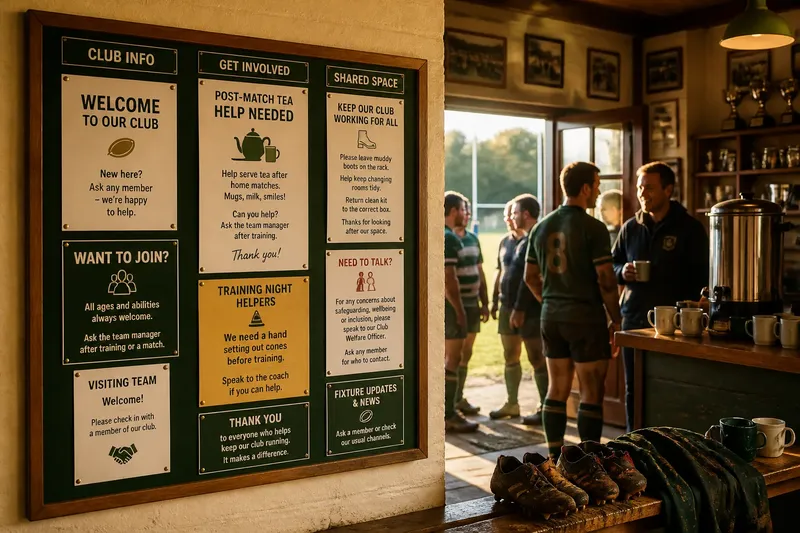
Someone arriving at the clubhouse with muddy boots and a question about post-match tea should not have to search through a phone thread to find the answer. A rugby club noticeboard can make practical details visible in the place where members meet, while giving newcomers an easy opening for conversation.
Place the board where club life naturally gathers
The best location is not simply the busiest wall. Look for a spot near the entrance, changing-room corridor, or tea counter where people can pause without blocking a doorway or the serving area. A board hidden behind a door may be tidy, but it cannot help someone who never sees it.
Consider the different rhythms of the clubhouse. Players may pass quickly on the way to training; families and supporters may linger after a match. Choose a height and position that make the notices readable for the people who use that space, and leave room for someone to stop without creating a bottleneck.
Keep the route to the board clear and make its purpose obvious.
Give the board a distinct job from club messaging
A noticeboard is most useful for information people can scan while they are physically together: where to return a borrowed jersey, who is setting out post-match tea, or where to ask about joining a team. It need not duplicate every message sent through email or a group chat. Instead, let the board serve as a visible prompt for the club’s shared routines and face-to-face help.
This distinction keeps the board from becoming a paper archive. A short notice can point to the right person or place, while a conversation supplies the context a sheet of paper cannot. Avoid printing long chains of updates that are easier to understand through the original communication channel.
Use the board to help someone take the next human step, not to reproduce every club message.
Make invitations concrete and easy to answer
“Help wanted” can sound like an undefined commitment. A better notice names a bounded task, when it is needed, and how to ask about it. That might mean setting out cones before training, bringing mugs to the tea counter, or helping welcome visiting players.
Make the invitation welcoming without assuming everyone has the same time or confidence. A contact name or clear place to ask can turn a vague request into a manageable conversation. Take the notice down when the task is covered so the next person does not respond to an old appeal.
Say you are putting up a notice for help serving tea after a home match. You name the task, state that a volunteer can ask the team manager after training, and remove the notice once the rota is settled; the expected result is a clear, low-pressure opening rather than an open-ended plea.
Keep shared-space notices useful and considerate
Clubhouses hold more than fixtures and team news. A board can help people understand shared habits, such as where to leave muddy boots, how to return clean kit, or whom to ask before using a room. Write these reminders as practical directions, not scolding messages; a newcomer should be able to follow them without already knowing club customs.
For a sensitive question involving safeguarding, access, or club policy, point readers to the appropriate responsible person rather than posting personal details or trying to settle the matter on the board. Follow the club’s current procedures, and ask a qualified or designated professional where the issue calls for it.
Write for the visitor who has not yet learned the clubhouse routine.
Make each notice legible at a glance
Use a short heading, readable lettering, and enough space between sheets to distinguish one request from another. Dark text on a plain background is easier to scan than pale colors or decorative lettering. Keep the board’s section labels consistent, but do not rely on color alone to communicate meaning.
Pin notices flat and avoid covering dates or contact details with other sheets. If a message needs a long explanation, put the essential direction on the board and direct the reader to a person who can talk it through. Stand where members would naturally pause and check whether the heading and next action are easy to pick out.
Read the board from the same distance a visitor would.
Use a simple review list to keep the board welcoming
During a routine look over the board, check each item and make a decision based on what you see. These checks focus on the board’s role in the clubhouse, rather than trying to make it a second messaging system.
- If a notice names a person or place to ask, keep it; if it leaves readers guessing, add a clear contact route or remove it.
- If a request describes a specific task and when help is needed, leave it up while relevant; if the commitment is vague, rewrite it or replace it with a direct invitation.
- If a shared-space reminder gives an understandable action, keep it; if it sounds like an unexplained rule, clarify the reason or direct readers to the responsible person.
- If a sheet is readable from the natural stopping point, leave it in place; if its heading or action is hard to see, reprint it more clearly or move it.
- If a notice contains personal information that is not needed for its purpose, remove those details; if a contact is necessary, use the club-approved contact route.
- If an invitation or reminder no longer applies, take it down; if the need remains but the wording is unclear, revise it before leaving it up.
Questions readers ask about a rugby club noticeboard?
What should a rugby club noticeboard include?
Useful items include directions for shared clubhouse routines, a clear route to ask about joining in, and specific invitations to help with a defined task. Keep the board focused on information people can use in the space, rather than copying every message sent elsewhere.
How often should a noticeboard be checked?
Check it as part of ordinary clubhouse upkeep and whenever a posted request or event has passed. The person checking can remove finished invitations, clarify anything confusing, and ask the relevant club contact about notices that may no longer apply.
Where should a rugby club noticeboard go?
Choose a visible place along a route members and visitors already use, such as near the clubhouse entrance or social area. Leave enough room for someone to stop and read without obstructing access or service.
Can a noticeboard replace conversation?
No. It can help someone find the right person or understand a shared routine, but questions about joining a team, volunteering, or club customs often need a human answer. Make that next step clear and welcoming.
Leave room for the conversation that follows
A rugby club noticeboard earns its place when it helps people share a space and take part without needing to know every custom in advance. Keep the directions brief, the invitations specific, and the route to a real person easy to find.
When you next pass the board, notice which item might prompt someone to ask a question. A useful notice does not have to answer everything; it can make that first exchange feel natural.