The Spare-Box Myth: Why a Rugby Club Store Needs a Clear Inventory
A rugby club store inventory helps volunteers find shared gear, separate ordinary stock from items needing qualified assessment, and decide what happens next.
“There should be a spare one somewhere” is a familiar answer when a rugby club cannot find a ball pump, bib, or set of cones. A rugby club store inventory can replace that guesswork with a clear record of what is present, where it belongs, and what needs a decision.
The useful distinction is between routine stock volunteers can count and safety-related equipment that requires competent assessment. The inventory can make both visible, but it should not turn an ordinary stock check into an inspection by someone who is not qualified to do one.
Keep routine stock separate from equipment requiring assessment
Begin with everyday shared supplies: balls, cones, bibs, pump needles, and clearly identified training aids. These can usually be counted, located, and marked according to their straightforward condition, such as ready to use or needing replacement.
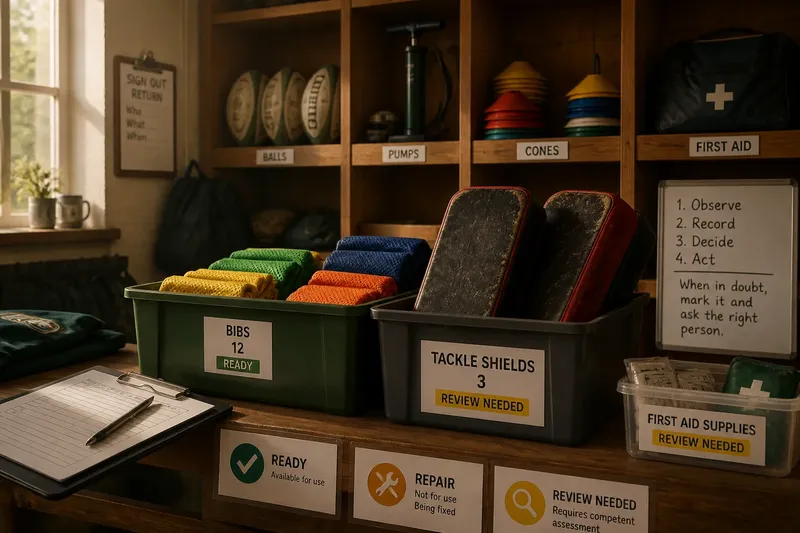
Record first-aid supplies, protective items, and other equipment whose suitability depends on labels, manufacturer instructions, or applicable requirements in a separate review category. A volunteer can note where such an item is and flag uncertainty; a competent person should decide whether it is suitable for use.
A simple record can include the item name, location, quantity, condition, and next action. Add an owner or team name when property is borrowed, donated, or not owned by the club.
- Observation: Matching cones are together in a labeled bin; if their number and condition are clear, then record them as one group; otherwise separate the damaged or unidentified cones for review.
- Observation: A ball pump is on its labeled shelf; if it is intact and ready for ordinary use, then mark it available; otherwise move it to the repair area and note who will follow up.
- Observation: A box contains mixed bibs; if the colors and condition are clear, then record the groups by color; otherwise sort them before entering a count.
- Observation: A first-aid supply package has unclear labeling or status; if a competent person can verify its suitability, then refer it for that review; otherwise keep it out of use and ask the appropriate qualified person.
- Observation: A protective item has no clear product information; if the instructions and suitability can be confirmed, then record the review decision; otherwise mark it not for use pending competent assessment.
- Observation: A donated item has no owner or intended use recorded; if the donor and a suitable club use can be confirmed, then assign it a location and owner; otherwise hold it separately while the club decides whether to decline or return it.
Use the same words on the record and the shelf labels. “Ready,” “repair,” and “review needed” are more helpful when each label has one clear meaning.
Make the status of every item easy to read
“Present” does not mean “available.” An item may be waiting for cleaning, repair, ownership confirmation, or a qualified assessment, so keep it apart from gear that volunteers can borrow without that unresolved question.
Imagine a club’s equipment lead starts with a labeled bin of twelve bibs and a separate box containing three old tackle shields; those quantities are invented for this example, not claims about typical club stock. The volunteer checks the bibs for obvious tears, records the twelve as ready if they are suitable for ordinary use, then labels the shields “review needed” and moves them to a separate holding area. The resulting record shows which group can be borrowed and which must wait for the equipment lead or another competent person to assess it.
When the status is uncertain, mark the uncertainty rather than guessing. The storage arrangement should make it difficult to mistake a pending item for ready stock.
Give unidentified and surplus items a clear route
A team may leave behind a bag, or a donation may arrive without a note. Before adding an unidentified object to routine stock, ask coaches and team managers whether they recognize it and whether the club has authority to keep it.
Use a temporary holding area with a named person responsible for resolving each entry. If nobody identifies a purpose or owner, record the club’s decision to return, relocate, donate, or dispose of it according to club practice.
For surplus items, distinguish “not needed by this team” from “no longer usable.” Another section may have a legitimate use, while shared or donated property may need an owner’s permission before it is passed on.
Set a checking rhythm volunteers can sustain
Update the sections that change when equipment is borrowed or returned, and review broader records at a point that fits the club calendar, such as before a new season or after a major event. A daily full count can burden volunteers, while a single annual check may leave routine loans unclear.
Say a volunteer opens the store before training and finds that the shelf label lists six pumps but only five are present. They check nearby containers and the loan note; if the missing pump is recorded with a team, they update its location, but if it remains unaccounted for, they mark it missing and alert the equipment lead. The record then distinguishes an expected loan from an unexplained absence.
Use a sign-out sheet, team label, or brief message to the equipment lead—whichever fits the way the club already shares gear. Record returns promptly so the next person can rely on the shelf list.
Choose a record volunteers can actually update
A shared spreadsheet suits a store where the relevant volunteers can access the current file. A printed shelf list may be easier in a room with limited phone or computer access; whichever format the club chooses, name one person to keep entries consistent.
Match the record’s language to labels on cupboards, shelves, and containers. If the spreadsheet says “training aid B” while the box says “old cones,” a volunteer has to guess whether they refer to the same thing.
Coaches and team managers can report loans, returns, and obvious shortages. The equipment lead can maintain the record and route uncertain or safety-related items to someone competent to assess them.
How should a rugby club resolve common inventory questions?
Does every item need its own spreadsheet row?
No. Group identical low-value supplies when they share a location and condition, and record items separately when ownership, repair, or identification makes that useful.
Should a club accept every equipment donation?
No. Confirm what the item is, who owns it, and whether the club can use and store it responsibly. If those points remain unclear, hold it separately while the club asks the donor or declines the offer.
What should volunteers do when the shelf and record disagree?
Check nearby shelves, containers, and recent loan notes before changing the entry. If the item is still unaccounted for, mark it missing or out on loan rather than silently changing the count.
Who decides whether safety-related equipment is suitable?
Refer the item to someone competent to assess that kind of equipment, taking manufacturer instructions and applicable requirements into account. The inventory volunteer can identify uncertainty and keep the item out of circulation, but the record itself is not a safety inspection.
A rugby club store inventory should guide the next decision
A useful rugby club store inventory tells volunteers where ordinary shared gear belongs, what can be borrowed, and who will resolve an open question. It also separates a genuine reserve from an unmarked box whose contents and condition nobody can explain.
Start with a few familiar shelves, label them to match the record, and give each unresolved item a responsible person and next action. When a club changes its storage layout, update the shelf labels and record together so the next volunteer can find the right answer without relying on memory.